The River Club sun & shading companion

Four o'clock on the fairway

Everything we know about the light on this side of Sandton: where it comes from, what it does to each wall of your house, and what we'd fit on each. Free to read, nothing to sign up for.

Written for River Club Sources listed at the foot About a nine-minute read
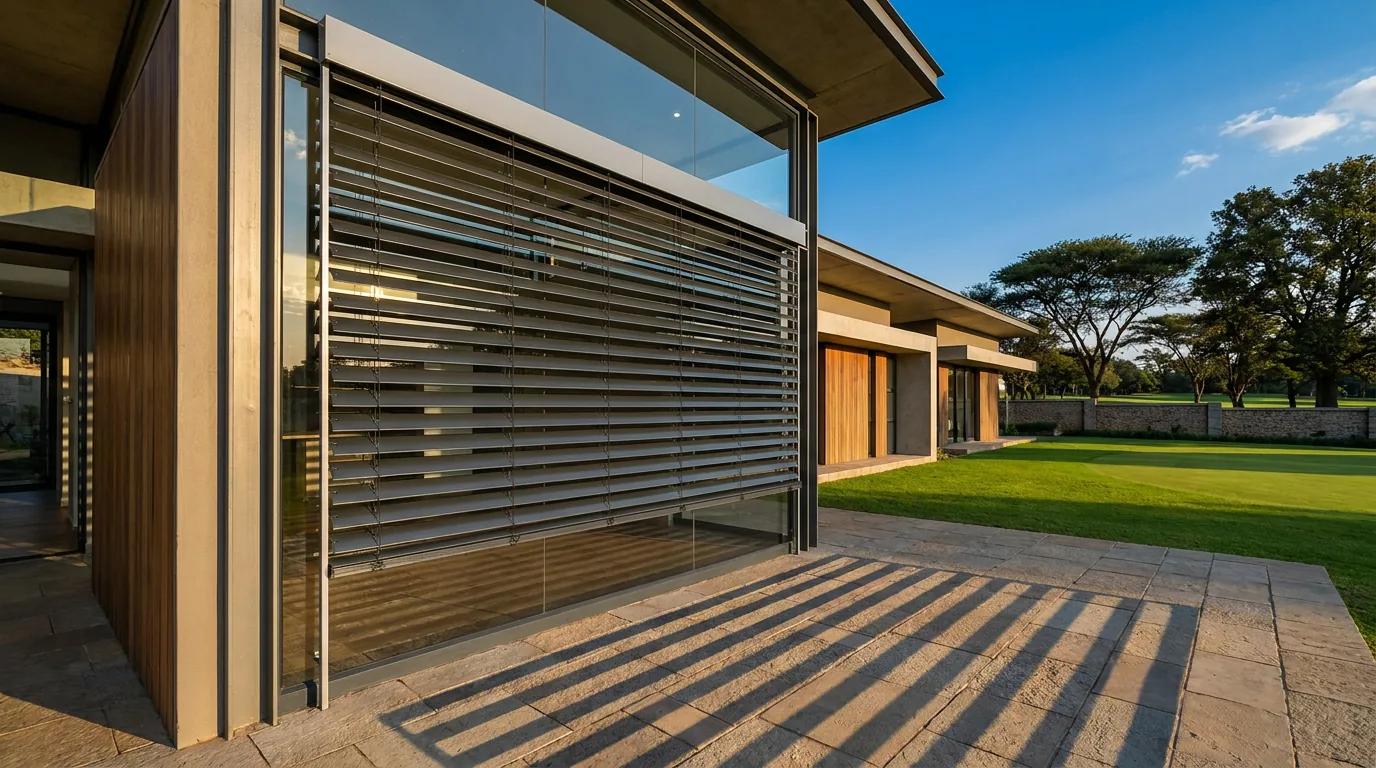
External venetian blinds mounted outside the glass of a west-facing living room in a Johannesburg golf-frontage home, their wide aluminium slats tilted against the low late-afternoon sun and casting banded shadows across the paving, with the fairway and mature trees beyond
Late afternoon on a west elevation: the heat is being stopped outside the glass, not after it.

Where you live

One suburb, two completely different briefs

River Club is a leafy pocket of roughly 2,600 homes south-west of Sandton, most of them large and screened by trees old enough to have arrived with the suburb. The land was farm — part of Driefontein, established in the 1840s — until a private golf club opened its course here in 1968. The houses on the frontage grew up alongside the fairways, which is why so many were designed around a view rather than the sun.

That leaves two separate shading problems in one suburb, wanting opposite answers.

The golf-frontage side. Big view-facing glazing, a low wall rather than a neighbour's roofline, nothing upwind of the patio but mown grass. Wonderful for the outlook — and the glass takes the full afternoon with no borrowed shade to lean on.

The greenbelt side. Ground falling toward the Braamfontein Spruit, Johannesburg's longest river and one of the longest urban greenbelts anywhere. Here the canopy already does half the work: rooms are darker and cooler, and over-specifying blockout is the commonest way to spend on a problem you don't have.

The useful question in River Club is almost never “what blind should I buy?” It is “which of my windows actually has a problem, and at what hour?”

What follows answers it in order: what the sun does here, what it does to each wall, what we'd fit and what's wrong with each option, and what nobody can tell you without standing in the room.

The light here

Almost overhead in December. Long and low in June.

Johannesburg sits at latitude 26°11′ south. On the December solstice the midday sun climbs to roughly 87° above the horizon — within a few degrees of straight overhead — and the day runs 05:13 to 19:00. Six months later that same noon sun sits low in the northern sky and the day is barely ten and a half hours long.

Two consequences follow, and they explain most of the shading mistakes we're called out to fix.

A roof overhang is a summer device, not an afternoon one. An 87° beam barely clears the sill, so an eave stops it. By four o'clock that sun has swung west and dropped, arriving almost horizontally under every overhang you own. Fixed shade can't follow it; adjustable shade can.

North is the elevation to keep, not kill. Here it's the north window that collects winter sun — a roughly 40° beam reaching metres into the room on a bright July morning. Block it permanently and you've bought a colder house for six months.

The Highveld then adds three of its own, each changing a specification.

  • Fierce ultraviolet. At 1,753 m under cloudless high-pressure skies, clear-sky summer UV here reaches an index of 13 — a fade-and-fabric question as much as a comfort one.
  • A hard storm season. Roughly 700 mm of rain falls October to March, largely as late-afternoon thunderstorms, with supercell frequency peaking in October and November.
  • Hail at the wrong hour. Hailstorms typically last about fifteen minutes and arrive mid-to-late afternoon — the hour your awning is most likely to be out.
  • A dry, frosty winter. July days reach 18–19 °C and nights drop to around 4 °C with frost common. Gauteng's strongest summer winds come predominantly from the east.
The sun over River Club, by season
SeasonNoon sun heightDaylightWhat it means for your glass
December solstice ≈ 87° — nearly overhead 05:13 to 19:00, 13 h 47 m Midday is easy; 15:00 onward is brutal on anything facing west. Early sun reaches south-side rooms too.
March & September ≈ 64°, due north at noon About twelve hours The transition weeks. North rooms start letting real depth of sun in; west is still hot late.
June solstice ≈ 40°, low in the north 10 h 30 m Free heating through north glass. Nights near 4 °C with frost common — insulation matters more than shade.

Solstice altitudes and day lengths are measured figures for Johannesburg; the equinox and June noon heights are the standard geometry for 26°11′ S. Sources at the foot of this page.

Wall by wall

Which of your windows actually has a problem

Walk the outside with a compass on your phone. Almost every River Club brief resolves into these four cases.

West · the hard one

The fairway lounge from three o'clock

If your main glass looks over the course, there's a fair chance it faces west. From mid-afternoon the sun is low, strong and arriving under the eave at seated eye level, and the room keeps radiating heat after it's gone. This is where an interior blind alone struggles: fabric behind glass still absorbs the energy that made it through the pane, then re-emits it inward.

What we'd do: stop it outside the glass if the budget stretches — external venetians or a zip screen — with an interior sunscreen roller behind as the everyday glare layer.

North · the one to keep

Winter's best asset, summer's nuisance

North glass takes high sun in summer, which an eave handles, and low sun in winter, which you want — so the answer is almost never blockout, but something you move with the season. The catch is fade: high-UV Highveld light takes timber, rugs and artwork faster than most people expect.

What we'd do: venetians or a light sunscreen roller — adjustable, never permanent.

East · the early one

Bedrooms and an 05:13 sunrise

Midsummer sunrise is 05:13, so east bedrooms take direct low sun an hour before most households want to be awake. There's a second question on the golf side: walkers and cart paths pass closer than a street would, and sunscreen that reads as reflective by day turns see-through once the lamps are on.

What we'd do: blockout in the bedrooms, or a double roller — sunscreen by day, blockout by night, one bracket.

South · the quiet one

Even light, and one summer surprise

South rooms get soft, even light most of the year and rarely need heat control. The surprise is midsummer: with the sun south of the equator in December it rises and sets south of the east–west line, so a south room catches raw low sun early and again near sunset — the two moments people forget when they decide “nothing needed here”.

What we'd do: the lightest thing that solves privacy.

What we'd fit, and the honest catch

Seven products, and what's wrong with each of them

Every option below is right somewhere and wrong somewhere else. Tap “add to my window list” on anything that sounds like your house — it'll be waiting, ticked, on the form below.

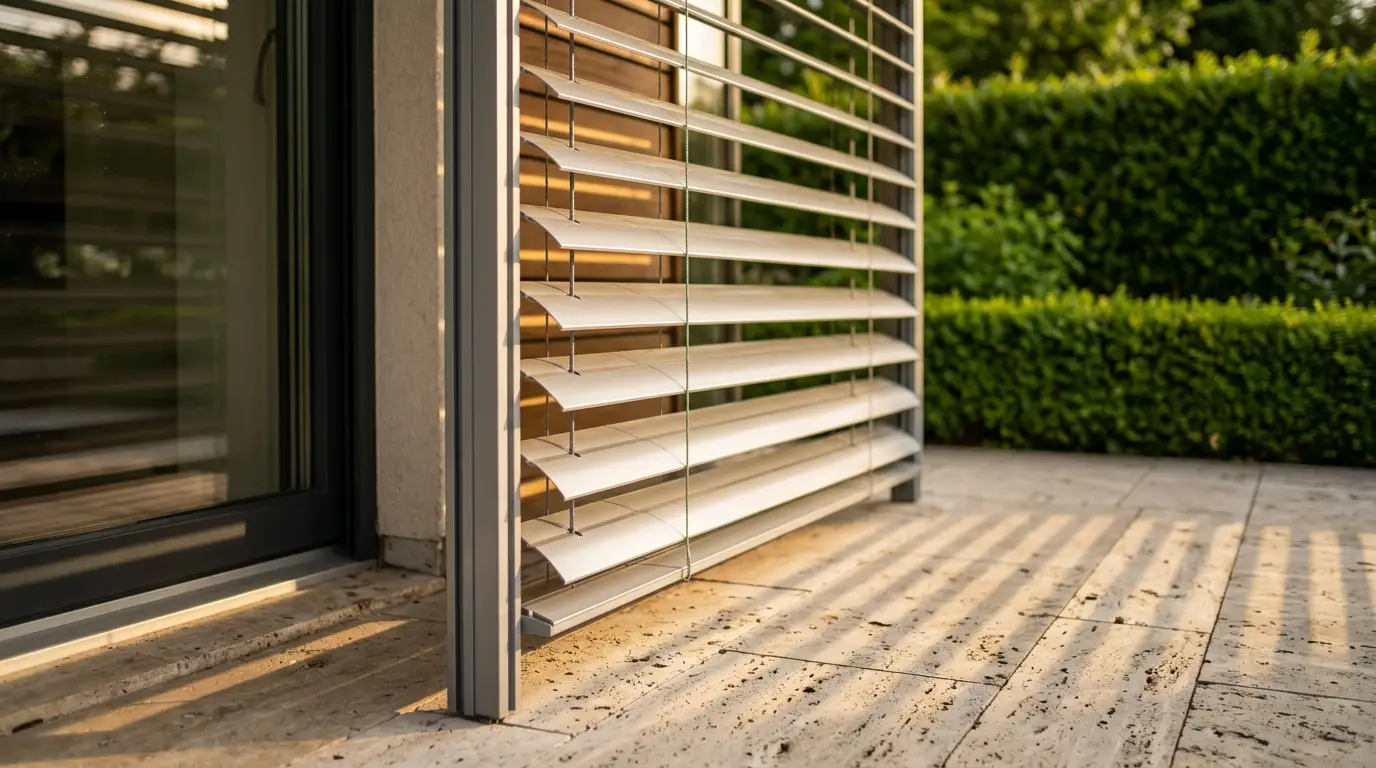
Close-up of wide aluminium external venetian blind slats running in vertical guide rails, tilted to cast striped shadow patterns onto travertine paving

For a west or north-west facade

External venetian blinds

Wide aluminium slats in guide rails, mounted outside the glass. They beat an interior blockout roller for one physical reason: they stop the sun before it reaches the pane, so the heat never gets in. Tilting them keeps the fairway view while cutting glare — a closed roller can't.

The honest catch: comfortably the dearest shading here, needing a motor and wind sensor to be safe outside, and cleaning because it lives in the weather. On a modest west window a sunscreen roller does most of the job for far less — we'll say so.

Read the product page
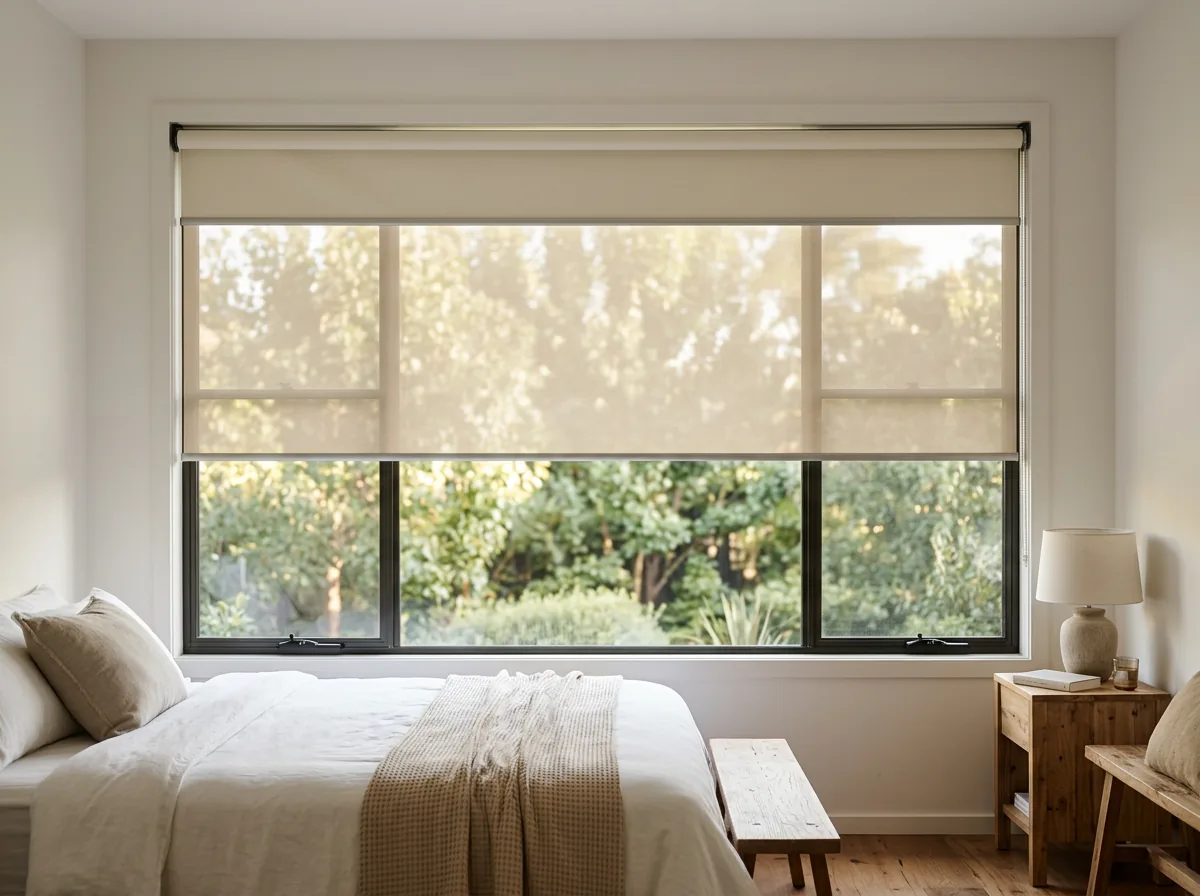
A sunscreen roller blind — one smooth flat sheet of open-weave fabric on a tube, with no folds or pleats — lowered two-thirds of the way across a wide bedroom window with garden trees beyond

Everyday glare, and bedrooms

Sunscreen and blockout roller blinds

One smooth flat sheet on a tube. A 3–5% openness sunscreen kills glare and much of the UV while leaving the fairway readable; blockout does what the name says. In an east bedroom, both on one double bracket is the honest answer to an 05:13 sunrise.

The honest catch: a sunscreen is only private while it's brighter outside than in; after dark that reverses. And an inside-reveal roller leaves a light gap at the edges — fine in a lounge, sometimes not in a bedroom.

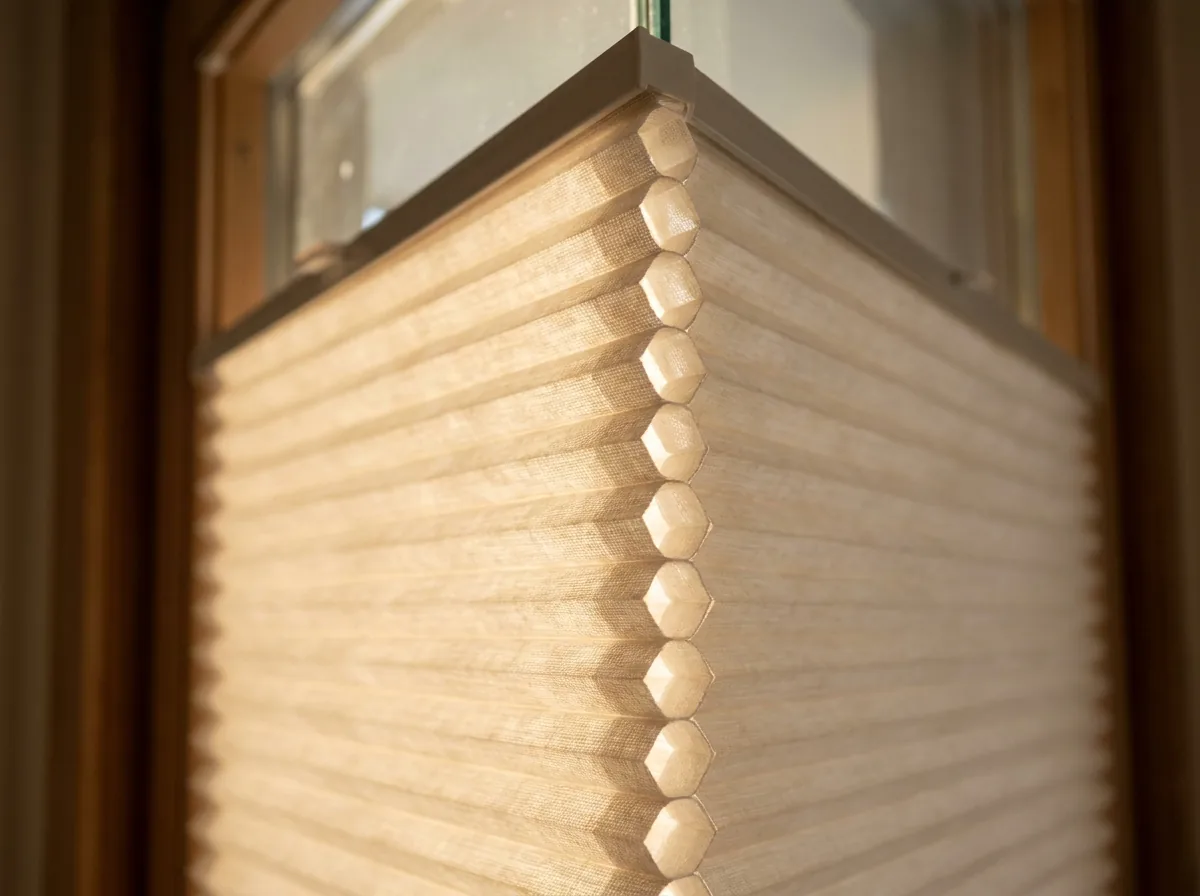
Close-up of cellular honeycomb blind fabric backlit by afternoon sun, showing the rows of hexagonal air cells that trap air against the glass

Rooms that must hold their temperature

Cellular honeycomb blinds

The fabric folds into rows of hexagonal cells that trap still air against the glass, and that works both ways — slowing heat in through a west window in January, and heat out on a 4 °C July night. Here you get both problems in one house.

The honest catch: you can't see through it. A light-and-temperature product, not a view product — so it belongs in bedrooms and studies, not across your best outlook. It also stacks into a deeper headbox than a roller.

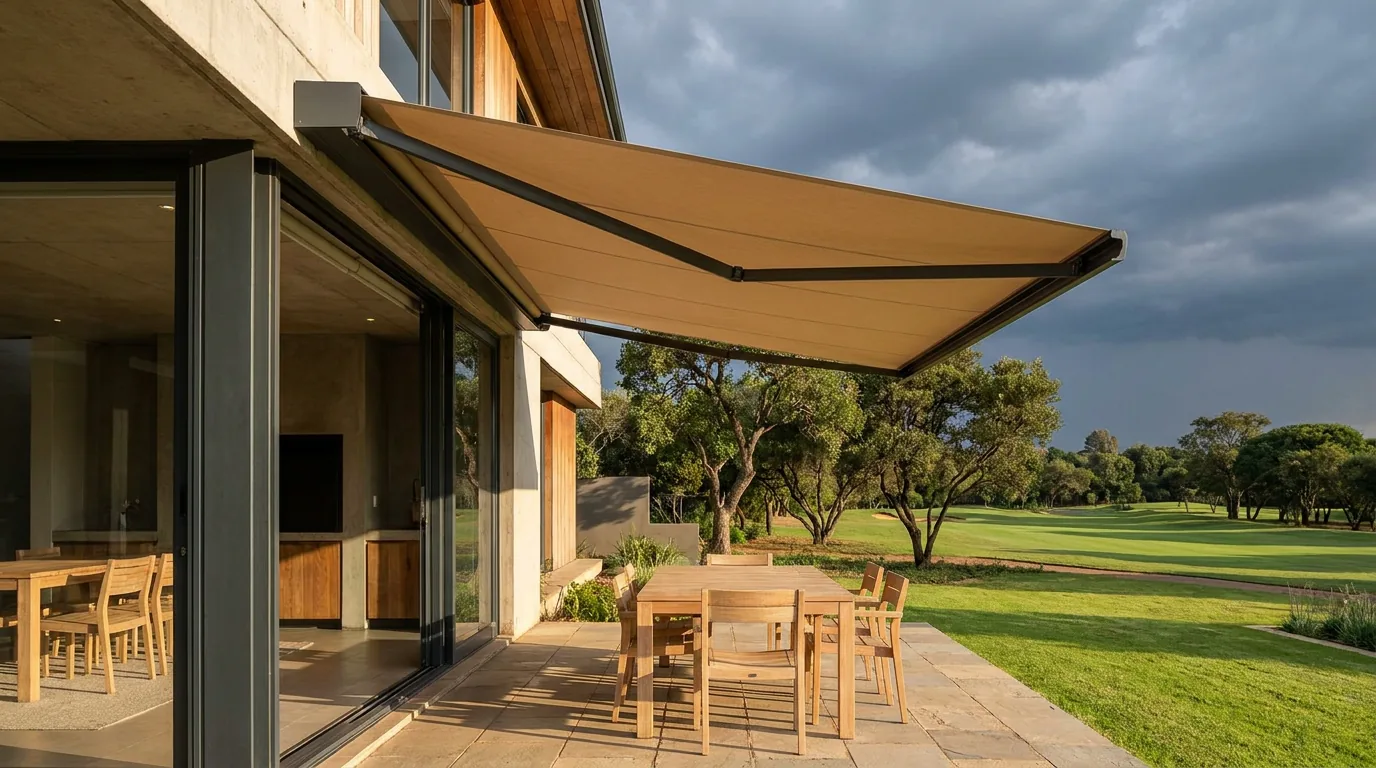
A folding-arm awning extended from a slim aluminium cassette over a patio dining table, shading it from the late sun, with the fairway and building storm clouds beyond

The patio, on the golf side

Folding-arm awnings

Shade you can put away — the whole argument on this elevation. You want cover over the table at four o'clock in February and it gone in June, so the winter sun reaches the back of the house. A fixed pergola can't make that choice.

The honest catch: fabric on arms is the most weather-exposed thing we fit, and the storm season peaks in the very hours you'd have it out. We won't fit one on an open fairway elevation without a wind sensor.

Read the product page
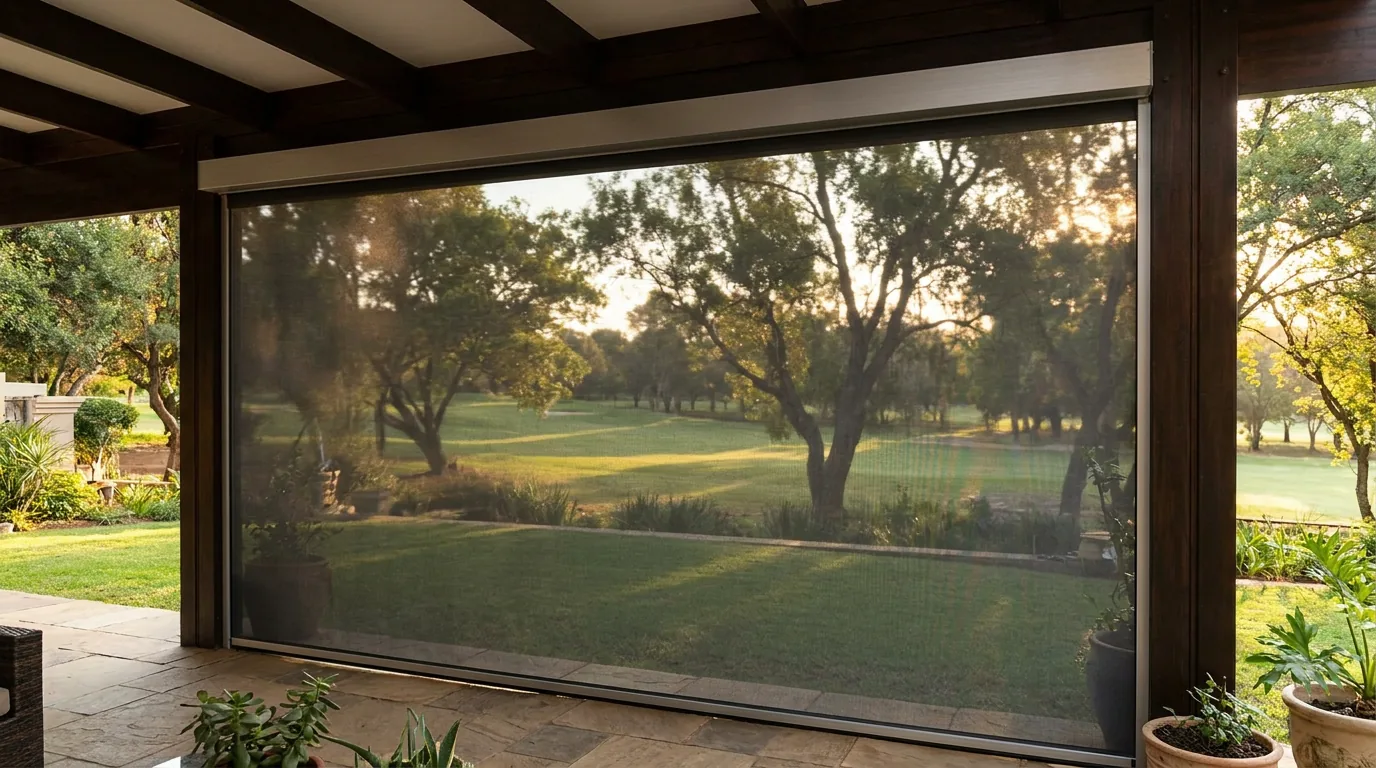
A zip screen rolled down from a headbox and held taut in aluminium side channels across a covered patio, the fairway and its trees still faintly visible through the dark mesh

A covered patio you want to use more

Zip screens

A single mesh sheet held in side channels so wind can't get behind it. On a fairway patio, where Gauteng's strongest summer winds cross open ground, that tensioned edge is the difference between a screen you use and one that flaps.

The honest catch: the channels are visible architecture, fixed to the structure, and they stay there. A far bigger commitment than an awning, and it wants a level, square opening to run in.

North rooms, kitchens, bathrooms

Aluminium or timber venetian blinds

The most literal answer to a north elevation, because the slat angle — not the blind's height — does the work. Tilt down in December to throw glare off the ceiling; open flat in July to let the low sun warm the floor.

The honest catch: more moving parts than a roller, more surfaces to dust. On wide spans they get heavy to lift, and timber slats don't enjoy a steamy bathroom — that's an aluminium job.

Anything high, wide, or outside

Motorised blinds & automation

On a stair void, a clerestory or a run of stacking doors, a motor is what makes a blind get used daily instead of left down all summer. It also unlocks the safety case outside: a wind sensor can only retract an awning if there's a motor.

The honest catch: the power has to arrive somewhere, and in an older River Club house that can mean a roof-void route or a battery motor. On a low, reachable window a chain is cheaper and lasts longer — we'll say so rather than sell you a motor.

Read the product page

Optional, and free

Want this marked up for your house?

Tell us which rooms or elevations are the problem and we'll send this guide back with our notes against your windows. No visit booked, nobody phoning you.

POPIA: your name and email are used only to send you this marked-up guide. They are not shared with anyone else and are not used for anything else.

Before anything is drilled

Estates, body corporates and the sixty-year line

River Club is a mix — large freehold homes, gated estates and sectional-title schemes side by side. Inside an estate or a scheme, the trustees or aesthetics committee usually have a view on anything visible from outside: a cassette colour, an external venetian's shade, a headbox breaking a facade line. We don't know your scheme's rules and won't pretend to — but we'll put a spec sheet together for that submission, free.

There's a second piece of paperwork almost nobody knows about. Under section 34 of the National Heritage Resources Act, no structure older than sixty years may be altered without a permit from the provincial heritage authority — and the trigger is age alone, not whether the house is a declared heritage site.

The course opened in 1968, so the oldest houses on the frontage reach that mark from roughly 2028. Most aren't there yet, and a blind inside a reveal isn't a facade alteration anyway. But if yours is one of the earliest and something is going to be fixed to an outside wall, ask before the holes are made.

The limits of a web page

Five things this guide genuinely cannot tell you

Everything above is true of River Club. None of it is true of your house until somebody has stood in the room — and these five answers, each needing a tape measure and a pair of eyes, decide the specification.

  1. The exact reveal depth, and what the top fixing lands in

    Whether a blind fits inside the reveal or has to face-fix outside changes the product, the light gaps and the price. So does what's above the window — a lintel, a brick course, or a plasterboard bulkhead with nothing behind it. Five minutes on site; guesswork from a photograph.

  2. What your trees are already doing at four o'clock in February

    River Club's canopy shades a great many windows for free, the greenbelt side more than the fairway side. Knowing which need nothing at all is worth as much as knowing which need external venetians — and that judgement is made standing in the room at four o'clock, not read off a plan.

  3. Where the motor power can actually go

    In a house built in the late sixties or seventies and extended since, there's rarely a neat cable route waiting. Sometimes the roof void solves it, sometimes a battery motor is the honest answer. It has to be traced, not assumed.

  4. How exposed your patio really is, and where a wind sensor must sit

    A fairway-side patio has far less upwind obstruction than a walled garden, but exposure varies with the trees, the boundary and how the house sits. A sensor mounted in the wrong pocket of still air won't protect the awning it's wired to.

  5. What the existing frames are — and which side the ground falls to

    Original sixties and seventies aluminium or steel frames take fixings differently to a modern replacement, and a renovated section may have both in one room. If your stand falls toward the Spruit, the low side also sits colder on a still winter night — pushing some rooms toward cellular blinds.

Two ways forward

Have us come and measure — or just get a range first

Both start on the form below. Neither costs anything.

Recommended

The free expert measure & written quote

A consultant comes to you with fabric and slat samples, walks the elevations at the hour that matters, measures every opening and leaves a written quote itemised per window. Free, no obligation.

Our consultant does five to six measures a week across this area, so the diary tends to fill a little ahead — worth booking early if you need a specific day.

Book my free measure

Optional

Want a ballpark first?

Pop in rough sizes and we'll send a budget range by the next working day. Not sure how to measure? Leave it out — our consultant measures for free either way, and that's where the exact per-window pricing comes from.

Open the window list

The close

Book your free expert measure

One short form. Want a budget range too? Add rough sizes underneath — optional, and nobody will chase you.

What you're interested in (anything you added above is already ticked)
Optional: add rough window sizes and we'll send a budget range

Rough really is fine — a tape across the outside of the frame is enough for a range, and we'll send one by the next working day. If measuring isn't your idea of a Saturday, skip this entirely: the free measure gives you exact per-window pricing anyway.

Your window list — room, width, drop, mount and product for each window
Room Width (mm) Drop (mm) Inside or outside the reveal Product Remove

Nothing on the list yet — and that is completely fine.

POPIA: your details are used only to arrange this call-back and, if you've added sizes, to send your budget range. They are never shared with any third party or used for anything else.

Sources

Where the numbers on this page come from

Every climate, sun-path, suburb and heritage figure above is taken from the following. Where something could not be verified for River Club specifically, we left it out or said so in the text rather than round it into a sentence.